
To start with, I conceived Leader Water as the third in a sequence of photo books concerning woodlands in the Scottish Borders. The first two volumes, The Heron Wood and Woodland, were printed commercially with soft covers. The intention, having seen how commercially printed monochrome works, was to print and bind the Leader Water book myself.
I’d been putting off writing about the Leader Water project until the end was in sight. The end however kept receding the further I got into the project. But now since I appear to have reached an end point, now’s the time to write about it. Appearances however can be deceptive!
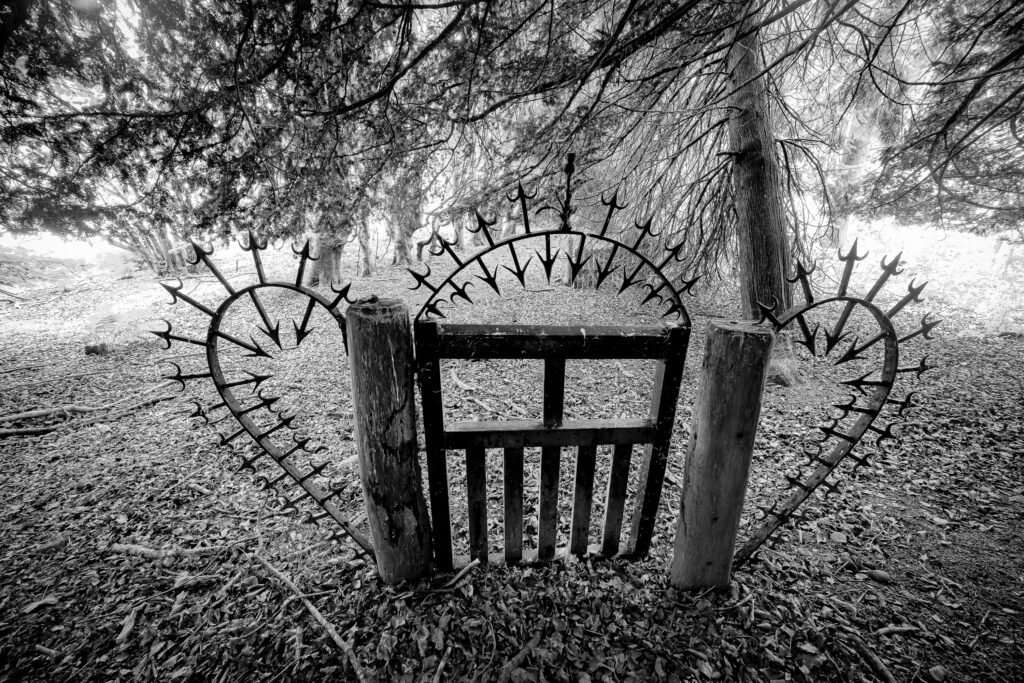
The valley of the Leader Water was one of the areas I visited during the photography for the Woodland book. It became obvious early on that there was enough variation to maintain the motivation for the repeat visits a book would entail.
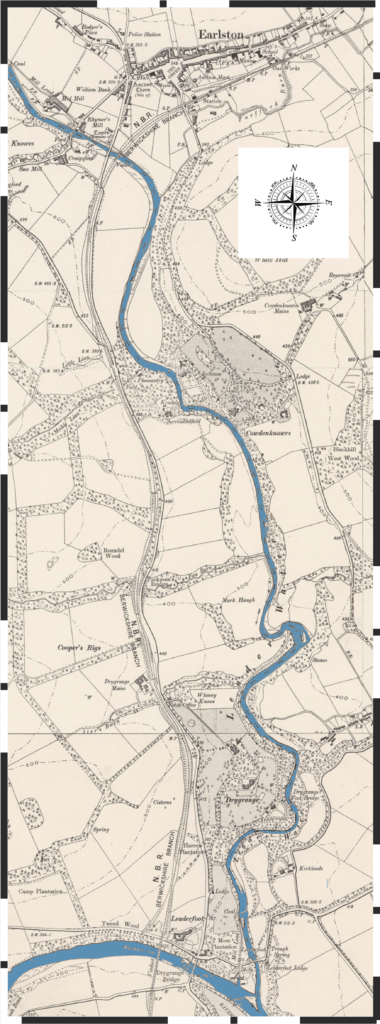
the National Library of Scotland
Starting from Leaderfoot, the point where the Leader Water flows into the River Tweed, I would walk up either side of the valley. The main tracks, maintained by the Earlston Paths Group, meander variously though the woods, and up and down the valley sides.

Over time though other routes suggested themselves, often following tracks made by land managers in the old estates
After a couple of years and over 30 visits I paused. I printed out 40 or so of the images I had gathered and set them all out on a table. My working assumption had been that the pictures would present a metaphorical journey. It would take the reader from creative despair to redemption, depths to heights and all sorts of other transitions. This as it transpired didn’t last long.
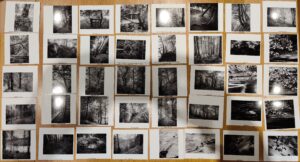
While I was photographing, my father became seriously ill, and passed away just as I finished my first set of pictures. The book took on a different guise: illustrating the transition from deep concern and worry to a position of equilibrium and acceptance.
So the chapters developed into their current shape: River, Labyrinth, Clearing and Canopy. They take the reader from the dark depths of the gorge, up through more complex areas to the clarity of the tops on the edge of the valley.
Having set out the pictures for consideration and repeating the exercise during a book making Open Studio workshop with Eddie Ephraums and Adrian Hollister, it became apparent where there were gaps to be filled. So I started revisiting the valley with particular pictures in mind – quite a different exercise from my original explorations.
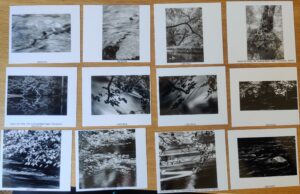
Meantime I was also revising my ideas of what a photo book could look like. I was interested in creating a book which encouraged readers to take their time working through the pictures and reading the text. There would be folded pictures with interesting reveals, rewards for unfolding the pages. I would make it awkward to simply flick through the book.
I was also keen after my experience with commercially printed photo books (at my price bracket) to take more control of the printed outcome. So a large Epson SC900 printer made its appearance in my work space, and I started investigating the opportunities and pitfalls of printing my own books. The print quality was exceptional and matched more closely my original intentions with my images. The page size was more of a challenge.
A book about 210mm square seemed a good size. Decent sized images but still readily handled by the reader. So for a standard two page spread suitable for a sewn binding, you would need paper 420 mm wide capable of double sided printing. So, A3 then. No problem. But I also wanted to include some folded pages which would take the paper size to A2 for those spreads where I wanted folds. Double sided A2 paper at a thickness suitable for page turning (as opposed to mounting in a picture frame) seemed a bit tricky to acquire.
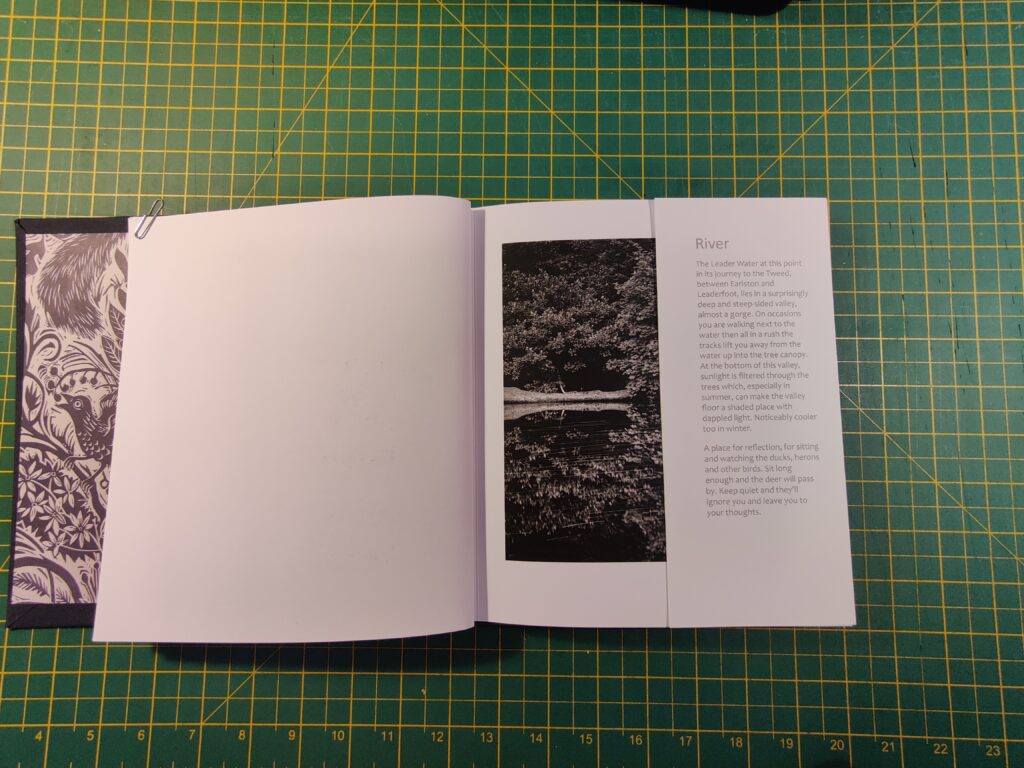

All this led me to consider a screw post binding where each page was bound separately. This would have the added benefit of the loose leaf arrangement so I could edit the sequence of pictures very easily. It also meant I could print each page (front and back) on a single piece of paper so A3 would be the largest size I needed with most of the pages being A4.
I mention all this in detail because the way the book handles seemed to me to be a critical element in the whole experience.
And so the first edition took shape.
But that’s just the first edition! Feedback from friends Rudolf Hummel and Norman Dodds inspired me to make a few changes. Some new images, removing a few less strong ones and adding a little more narrative all to help the momentum through the book.
For the time being this is now a completed project. But inevitably I’ll see different things to do with it. Coming back to the idea of a trilogy of books, I’ll certainly have to reconsider the idea of a sewn binding, even for the folding pages.